With nobody at the keyboard, the dispatcher keeps the line moving.
The line’s skills start when someone types them. At night, in a meeting or away from the desk, nobody does, and the work waits at the next station. The dispatcher is a small program on the machine that runs the agent sessions. A timer runs it every few minutes, and each run, a tick, starts the stations that should be running and are not.
It starts stations on the line. What stays with a person is on the overview.
- the tracker
- the pull requests
- the sessions already running
- the records it keeps on the machine: the sessions it launched
- the nudges
- notifications already sent
- the outcome of each stage
- pickupstation 1, Pick up
- re-armstation 4, Drive
- re-drivestation 4, Drive
- follow-upstation 7, Follow up
- a question a drive parked for a person
- a failed follow-up
- a pickup that stalled
The upper rail, at station 6, Merge: a person merges
- 1Pick up: pickup
- 4Drive: re-arm · re-drive
- 7Follow up: follow-up
The dispatcher starts these stations when nobody does, every few minutes. It never merges. ↺ Follow-up items enter the line again at station 1.
Each tick reads the tracker, the pull requests and the sessions already running, and the records it keeps on the machine: the sessions it launched, the nudges and notifications already sent, and the outcome of each stage. Those records survive stopping the dispatcher, so a restart loses nothing and starts no stage twice. Then it starts:
A pickup for each item assigned to the repository’s factory identity: the tracker user a team assigns work to when the factory should take it. The session claims the item and carries it to a pull request.
1Pick upA re-arm of each drive that stopped on something a machine can settle: a usage limit, on another account, or a question a person answered.
4DriveA re-drive of each converged drive gone stale: its pull request now conflicts with its base, or its head moved past the head the drive checked. A drive that stopped on a conflict it could not repair gets one too, once for each state of its pull request and its base. So does a drive parked on a question whose pull request comes to conflict, so the person who answers finds the branch up to date. A person hears of the conflict only if that re-drive does not resolve it.
4DriveThe follow-up after each merge, which settles what the merge owes.
7Follow up
A tick reports what it would start, and why, before a team lets it start anything. Every session it starts gets a launch record first, so a launch whose answer is lost is never followed by a second one.
The dispatcher opens workspaces and starts agents through a session runtime. Orca is the first one. Another runtime, Herdr among them, joins as a second implementation of the same interface once it can list a host’s accounts. On Orca, the dispatcher starts pickups and follow-ups as non-interactive agent runs, or headless passes, on the account it chose. An interactive pickup session waits until the runtime can bind it to an account. The dispatcher ships in the plugin, and the jig command installs its timer and checks it.
Some stops only a person can settle: a question a drive parked for a person, a failed follow-up, a pickup that stalled. The dispatcher sends every such message for a repository to one place: its notices workspace, or a workspace the team names. With Orca, the message becomes that workspace’s comment, and the dispatcher marks the workspace unread, which Orca’s phone app shows. A message whose cause still stands goes again the next day. A person answers a parked question with a comment on the pull request, and the next tick re-arms the drive.
A running stage can fall short of what it should achieve: a drive whose open review threads stop falling, or a pickup with no pull request in time. That is stage drift. The dispatcher reports it and tells a person once, and the person decides whether to stop the stage.
Nothing needs restarting after a night: the timer ran every tick. In the morning one report lists what each drive did and what the dispatcher started, refused and notified. A person answers the parks, settles what only a person can, and merges what converged.
A team can turn on dispatch labels. They show each pull request’s state where the pull request lives, on the forge: driving, converged, parked or held, among others. A person steers with two labels of their own. One asks for a drive, and the other keeps the dispatcher off the pull request.
Every session the dispatcher started leaves one row in the outcome log when it ends. The row holds the stage, the repository, the account, the model, how long the session ran and how it ended. How it ended is one class from a closed list: converged, merged, a usage limit, parked for a person, waiting on a pending step, stalled, died, refused, or gates failed. A follow-up waiting on a pending step, or a session that stopped on a question for a person, never counts as a failure. A wait on a rate limit is logged as a usage limit. The log records a stop no class fits as unknown, and never drops it.
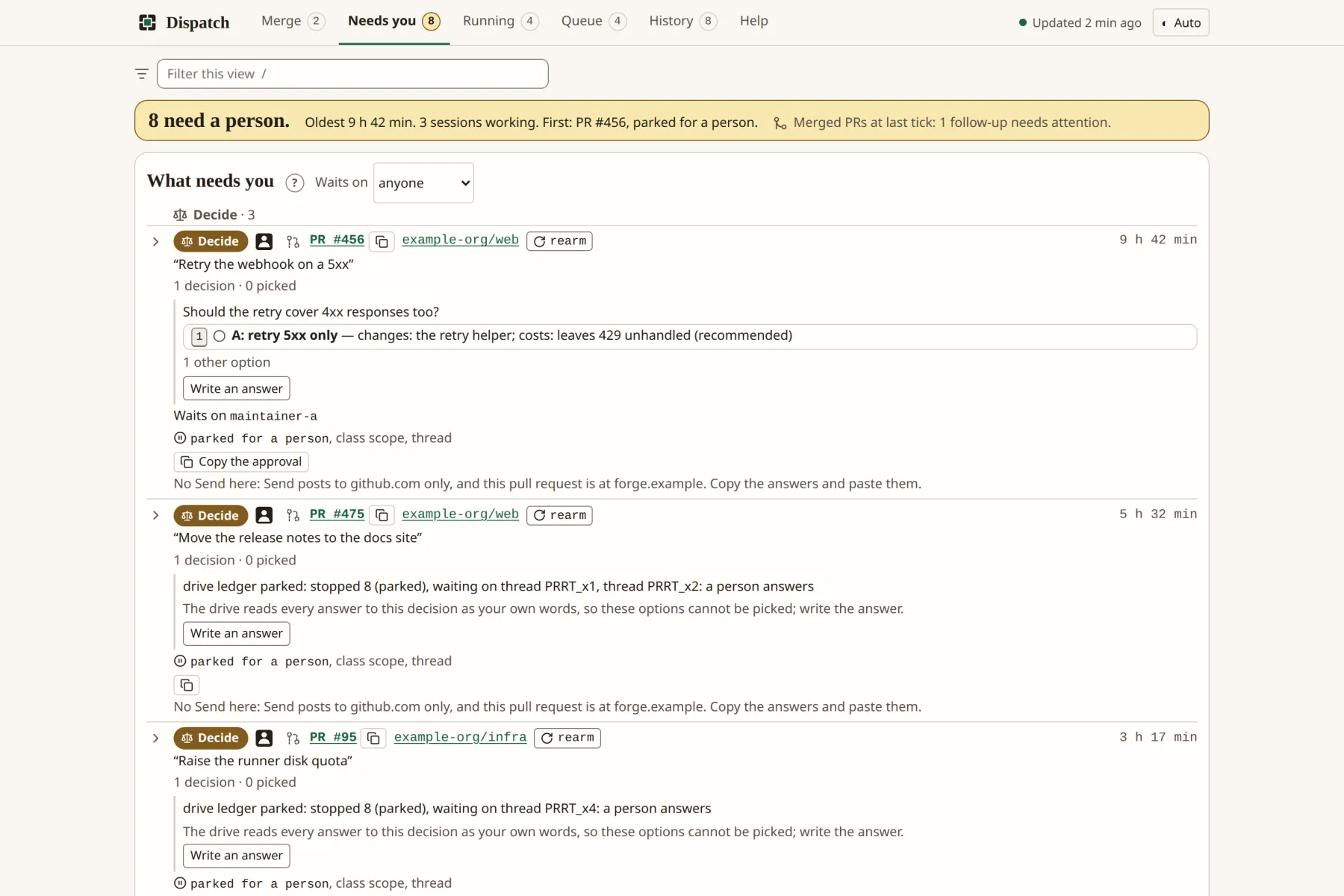
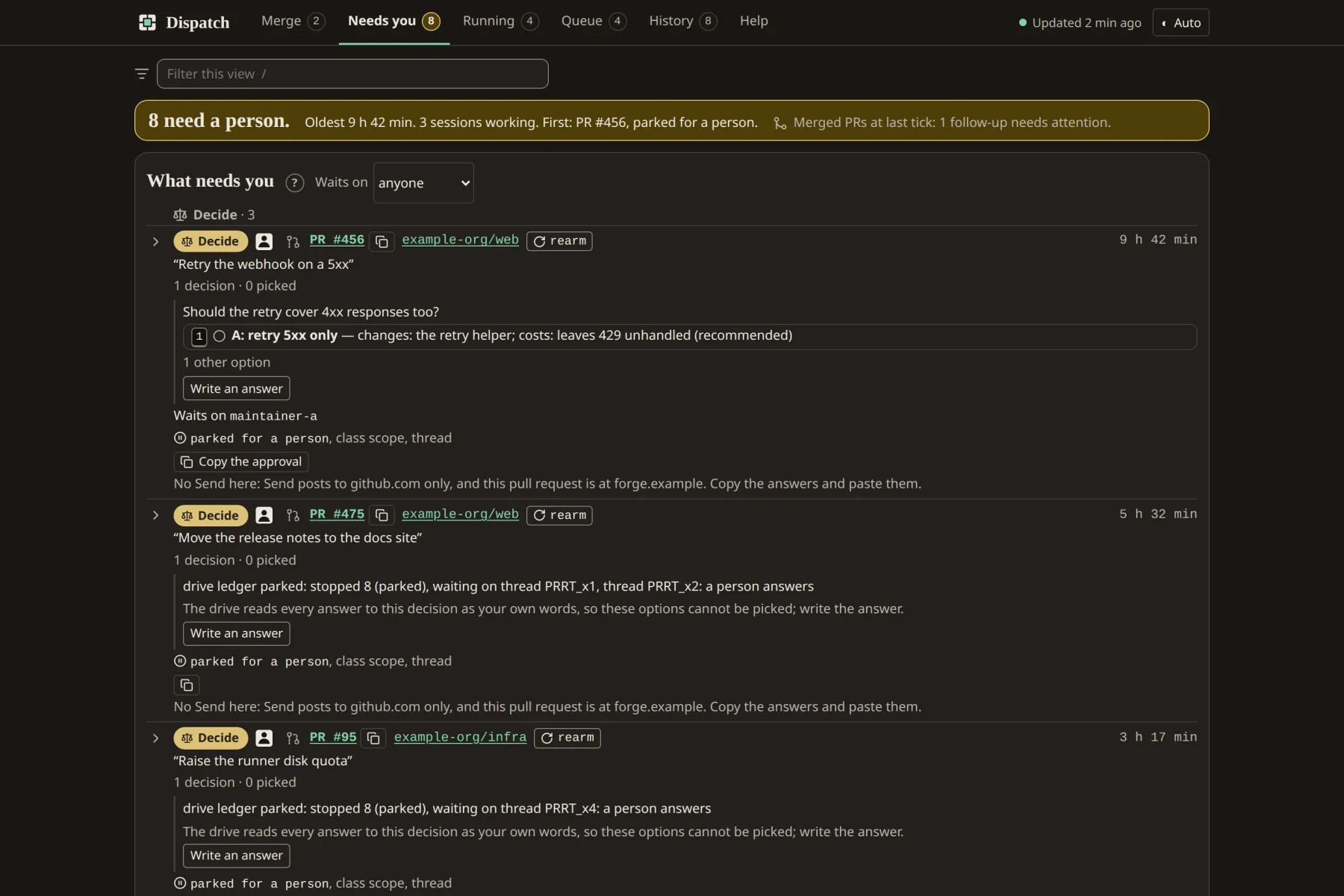
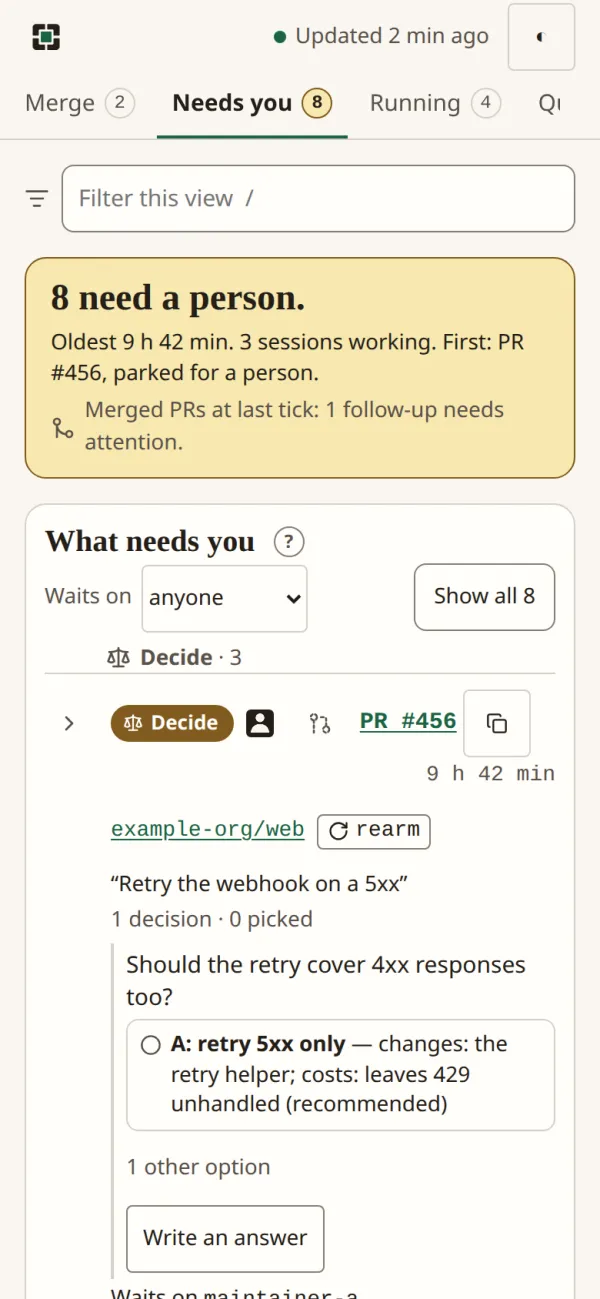
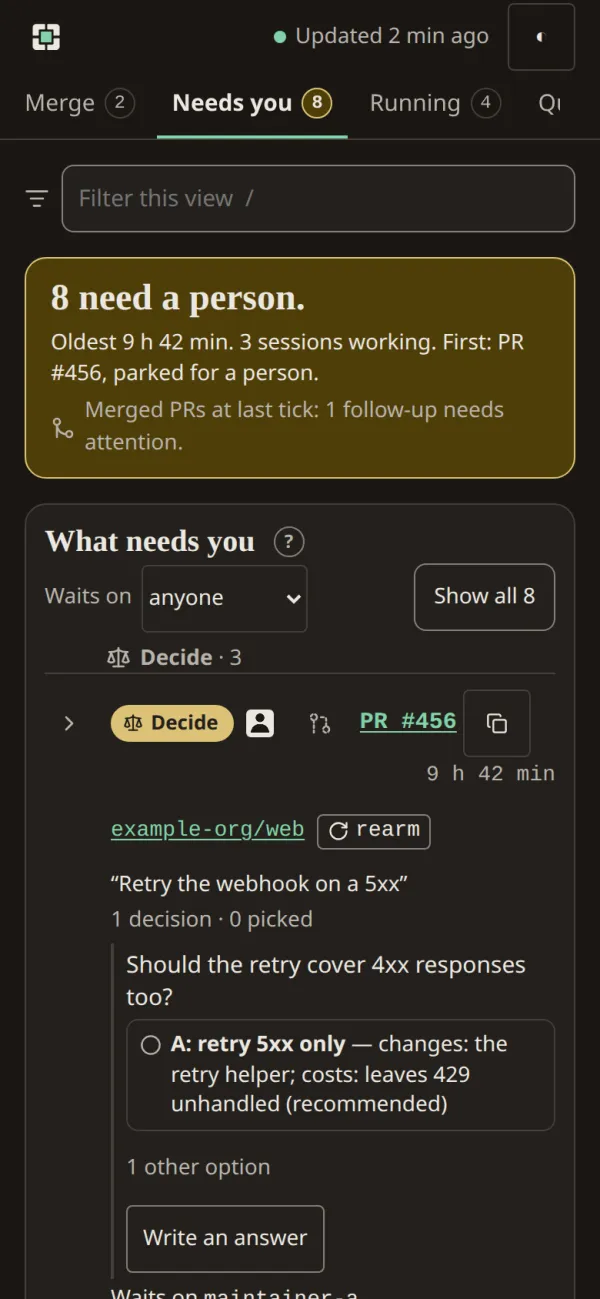
One dashboard opens on the pull requests ready to merge, or on what needs a
person when none are ready. Its other views show which account holds which
session and what comes next, as the newest tick found them. A last view filters
the log by time, repository, stage, account and class, and counts each class. A
phone opens it as well as a desk. Its server only reads and makes no report files. Its page can post a parked
decision’s answer as the person. That is Send, with a GitHub token the person keeps in that browser. A confirmation
shows the target and the answer first. The comment is the one jig send writes, and until the line can tell a session’s
comment from a person’s, it is trusted as one jig send posts from a terminal. Without a token, the person answers on
the pull request or with jig send. A class that keeps coming back is a finding about
the scaffolding, and the learning loop is where
a person approves the change.
Each session bills to a subscription account, Claude Code’s or Codex’s, and the account decides which agent the session runs in. Each account runs a capped number of sessions at once, each one a slot. When a session stops on an account’s usage limit, the dispatcher records a wall. It leaves the account out of every launch until the limit resets. A drive stopped there is re-armed on another account at the next tick. A Codex account is admitted only on a machine that opted in to running Codex without its sandbox, since nobody is there to approve.
Once a limit resets, an interactive session the dispatcher started whose last record is still that limit gets the one nudge the dispatcher ever types, a fixed sentence asking it to continue. It is sent only when the agent’s input line is empty, no menu or question is showing and nobody has the workspace open. Anything else a stuck session needs goes to a person.
Some pull requests conflict whenever two move at once: two migrations, or two edits to one schema. A team marks such an area as a serialized area in its change-area catalog, the file that says what each kind of change implies. The dispatcher drives that area’s pull requests one at a time, the one closest to merge first. The others wait, held, and the outcome log records how long each waited. A person adds the mark, never the dispatcher.
- Never: Merge. A person merges, here as at station 6.
- Never: Answer a parked question. The question is a person’s, and so is the answer.
- Never: Start a second session on a claimed item. A stalled pickup, or an item two sessions joined, goes to a person.
- Never: Stop a driver that is making progress. It takes over only a stalled driver: one its own machine started, or one whose process is gone or stuck, whoever started it.
- Never: Change its own limits. A class that recurs on the dashboard is recorded as a finding, and what to change is a person’s decision.